Example Of Default Constructor In Java . Here in this example, employee object is created using below line of code. In case you do not specify any constructor, the compiler will generate a default constructor for you. How Default Base Class Constructors Are Used with Inheritance Webucator from www.webucator.com Java automatically generates a default (no arguments constructors) for classes that don't have any constructor. The constructor is a unique method used to initialize the object. The default for constructors is that they do not have any arguments.
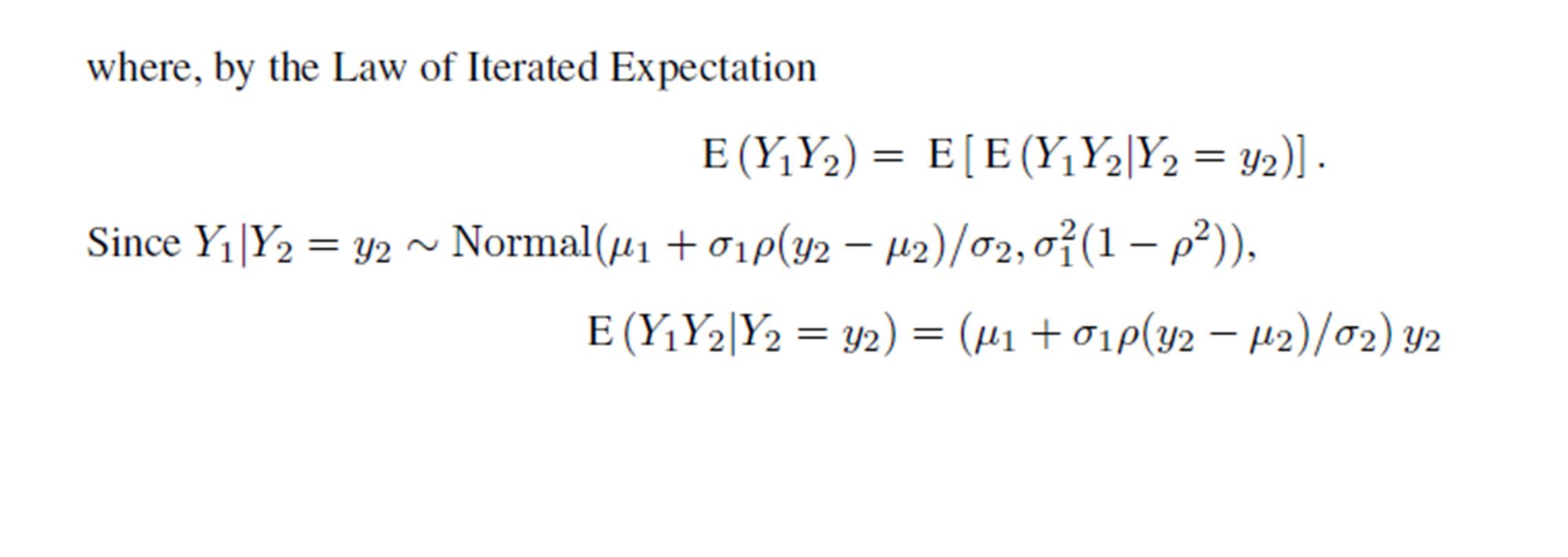
Law Of Iterated Expectations Examples. In the meantime, we'll have a look at simple examples that explain a lot about conditional expectations. The law of iterated expectation states that the expected value of a random variable is equal to the sum of the expected values of that random variable conditioned on a second random variable.
probability Iterated expectation Mathematics Stack Exchange from math.stackexchange.com
In section 5.1.3, we briefly discussed conditional expectation.here, we will discuss the properties of conditional expectation in more detail as they are quite useful in practice. The law of iterated expectations, sometimes called the law of total expectation, tells. F(x) p(a) x 2 a 0 x =2 a note that the support of fxja is supported only in a.
To See This, Firs T.
Sample mean sample variance distributions for a normal population parameter estimation. Double expectations example involving 3 doors. Laws of total expectation and total variance de nition of conditional density.
The Law Of Iterated Expectations (Lie) States That:
Law of iterated expectations example; Notes on law of iterated expectations cyrus samii the law of iterated expectations is the foundation of many derivations and theorems in applied statistics. The words at the top of the list are the ones most associated with law of.
View Law Of Iterated Expectations.pdf From Econ 704 At University Of Wisconsin, Madison.
A basic statement is as follows: E ( y ∣ x) = { 1 / 2 if x = 0 0 if x = 1 } = { 1 / 2 with probability 2 / 3, 0 with probability 1 / 3. You get e x k + 1 = e x k.
The Unknown Parameter U Shows How The Expected Value Of Y Changes With X.
So we look at e ( y ∣ x) : Law of iterated expectations guillem riambau. Intuitively speaking, the law states that the expected outcome of an event can be calculated using casework on the possible outcomes of an event it depends on;
Use Property Ce.2 Along With The Law Of Iterated Expectations, Property Ce.4.
Let m i ∈ p denote the observed value of a continuous variable that is realized after the exposure to the treatment where p is the support of m i. In section 5.1.3, we briefly discussed conditional expectation.here, we will discuss the properties of conditional expectation in more detail as they are quite useful in practice. We will also discuss conditional variance.


Comments
Post a Comment